

4 Best EMR Systems for Longevity Clinics (September 2026)
September 2026 rankings of the 4 best EMR systems for longevity clinics, rated on AI architecture, lab ordering, and membership billing.

TL;DR
5 key points- 01Longevity clinic EMRs need native high-risk payment processing for peptides, semaglutide, and TRT/HRT that standard processors reject
- 02Eight criteria separate a purpose-built longevity EMR from a repurposed general system, including ambient scribe, lab ordering, and membership billing depth
- 03OptiMantra, PracticeQ, and PatientNow each support insurance billing but lack AI-native architecture and advanced membership configuration
- 04PatientNow added AI through a 2025 acquisition, meaning the AI layer sits on top of a legacy system instead of running natively
- 05Decoda Health is the only reviewed system with native high-risk payment processing, tiered rollover membership billing, and an AI Scribe built into the core product
What Is an EMR for Longevity Clinics?
A longevity clinic EMR is the software system that manages clinical records, scheduling, billing, and patient communication for practices focused on healthy aging and performance medicine. It covers the full scope of what these practices do: hormone optimization, peptide therapy, NAD+ infusions, GLP-1 programs, advanced diagnostics, and structured wellness protocols that run for months or years at a time.
General-purpose EHRs were built for episodic, insurance-billed care, and that distinction matters more than it might seem. Longevity clinics depend on recurring memberships, cash-pay programs, and services like semaglutide and peptides that require high-risk med spa payment processing in categories most mainstream processors refuse to support.
Longevity care is longitudinal by design, which shapes what the software needs to do. Patients follow structured protocols over months, return for regular lab draws, and build a biomarker history that informs every subsequent visit. The right EMR brings lab ordering, clinical notes, care plan delivery, and membership billing into one connected workflow so nothing falls through the gaps between tools.
How We Ranked the Best EMR Systems for Longevity Clinics
These rankings come from hands-on review of what longevity clinic operations actually require. Each system was measured against the same eight criteria, grounded in the workflows this specialty runs on and informed by our broader look at the best medspa EHR software.
Here are the eight criteria we weighted across every system reviewed:
- AI architecture: whether AI is built into the core system or added through acquisition after the fact
- High-risk payment processing: native support for peptides, semaglutide, and TRT/HRT without relying on processors that freeze funds
- Membership and package billing depth: ability to run multi-tier, recurring programs with rollover and flexible cadences
- Native lab ordering: direct Quest and LabCorp connections with results populating the patient chart automatically
- Ambient clinical documentation: real-time note generation without a separate permission step or manual transcription
- Omnichannel scheduling: web, text, and social booking with smart resource routing
- Inventory tied to treatment deductions: unit-level tracking linked directly to what was charted and billed
- Customer support responsiveness: how fast a real person responds when something breaks
Every system reviewed has gaps somewhere across these eight criteria. The rankings reflect overall performance across the full set, so a strong showing in one area does not outweigh weaknesses in others.
Best Overall EMR for Longevity Clinics: Decoda Health
Decoda Health is an AI-native EMR designed specifically for elective and longevity care, where the clinical and administrative workflows share a common foundation. Patient calls, recurring membership billing, and clinical documentation all run inside one system, with AI woven into each layer from the start.
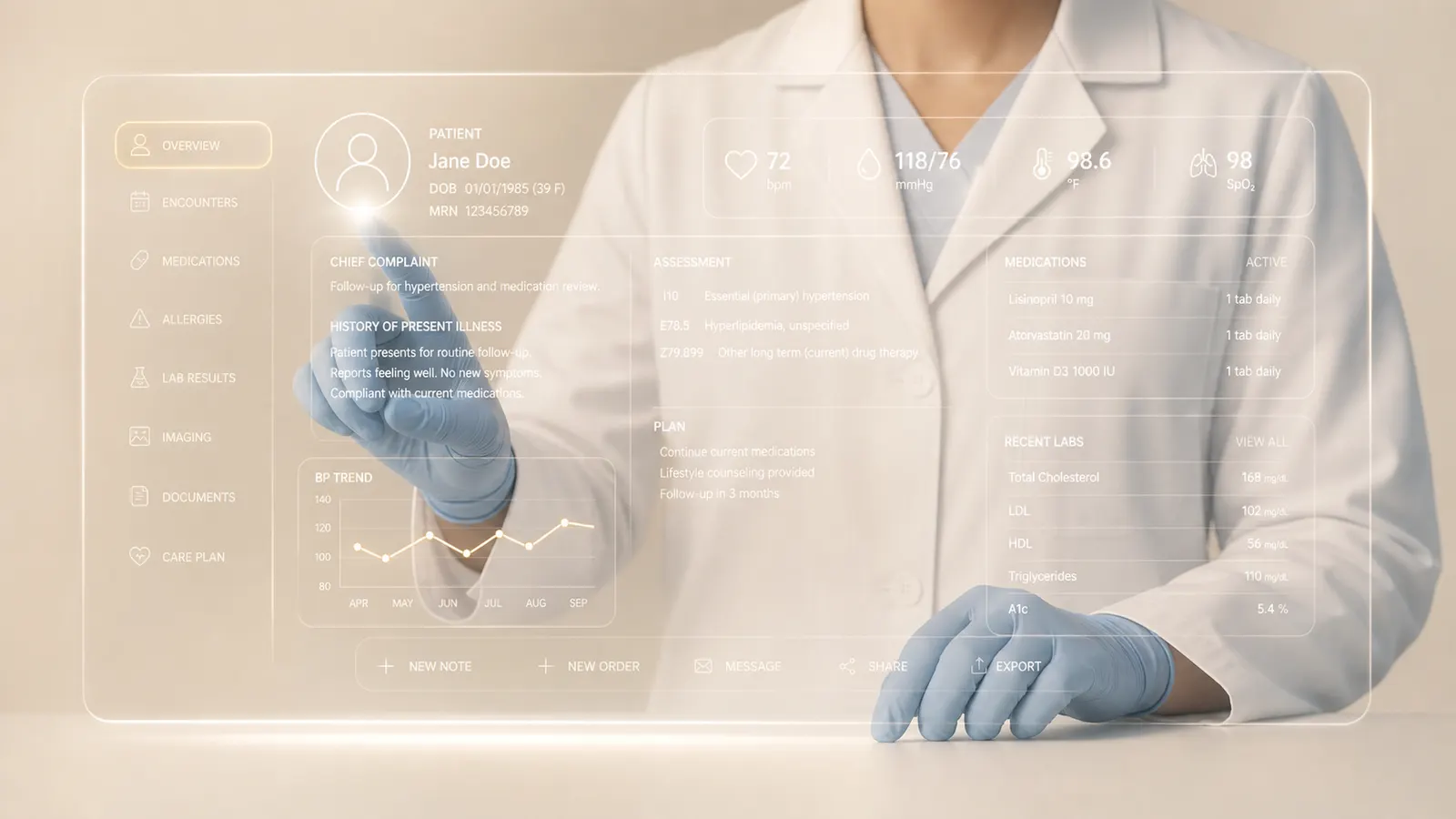
- AI-native architecture across the full clinical and administrative stack, purpose-built from the ground up instead of acquired and integrated
- High-risk payment processing supporting peptides, semaglutide, ketamine, and TRT/HRT, without the fund-freezing risk that comes with standard processors
- Advanced membership and package billing with per-item rollover, tiered discounts, and 6-, 10-, and 12-week billing cycles aligned to GLP-1 peptide programs and structured wellness programs
- Ambient AI ambient scribe that generates compliant SOAP notes in real time, with longitudinal patient context and no separate permission step required
- Native med spa EMR lab ordering with Quest Diagnostics and LabCorp integrations, with results auto-populating patient measurement tables and plotting on trend charts automatically
- AI-powered med spa injectable inventory tracking tied directly to treatment deductions and patient charts, tracking usage down to the unit
For longevity practices running recurring revenue programs and longitudinal clinical protocols, Decoda Health covers those workflows within a single AI-native system in a way the other options on this list do not match natively.
OptiMantra
OptiMantra was designed with naturopaths, acupuncturists, and multi-modality integrative providers in mind. The system handles cloud-based scheduling, charting, telehealth, insurance billing, inventory, and lab and prescription workflows, with customizable templates that suit a wide range of care models.
For small to mid-sized integrative practices billing insurance or managing physical product inventory across therapy disciplines, it covers the core bases well. Where it starts to feel limited is in practices that have moved toward a recurring-revenue model. There is no ambient scribe, AI-native front desk layer, or membership billing configuration deep enough to support tiered program structures. Longevity clinics building that kind of infrastructure will likely need to look elsewhere, and Decoda Health is one option purpose-built for that work.
PracticeQ
PracticeQ is a cloud-based practice management tool built for solo practitioners and small wellness or therapy clinics. Scheduling, intake, billing, and telehealth live in one system, and the client-facing portal handles appointment package intervals and basic intake without much friction.
For a mobile IV therapy or concierge health practice that needs something lightweight to get off the ground, it is a sensible starting point. Growth, though, tends to expose the edges of what it can do. Membership billing configuration stays fairly shallow, AI-powered clinical documentation is not part of the product, and some deployments route patients through an external intake flow rather than the clinic's own site. For a practice building a peptide clinic or a full longevity program with recurring protocols, those constraints become harder to work around over time. Decoda Health was built to handle that kind of program depth from the start.
PatientNow
PatientNow is an aesthetic EMR that centers on app-integrated photo documentation and before/after tracking, with patient communication tools, automated follow-up, and practice management reporting designed for single and multi-location aesthetic practices. AI capabilities came through the acquisition of Recura AI in late 2025, which means the AI layer was integrated on top of an existing system rather than built into the foundation.
For mature aesthetic practices where photo documentation is the primary workflow and there is no need to build complex membership programs, it holds up well. The friction shows for longevity-focused practices. Because the AI was added through acquisition, it runs on top of the legacy product rather than through it. Membership billing is also constrained; practices that have migrated away from PatientNow often point to the need for med spa membership pricing and tiers that support multi-frequency, rollover-capable billing as the reason, something PatientNow's current configuration does not cover.
Feature Comparison Table of the Best EMR Systems for Longevity Clinics
Feature | Decoda Health | OptiMantra | PracticeQ | PatientNow |
|---|---|---|---|---|
AI-Native Architecture | Yes | No | No | No |
High-Risk Payment Processing | Yes | No | No | No |
Advanced Membership and Package Billing | Yes | No | No | No |
Ambient AI Clinical Scribe | Yes | No | No | No |
Native Lab Ordering (Quest/LabCorp) | Yes | No | No | No |
AI-Powered Inventory Management | Yes | No | No | No |
Insurance Billing Support | No | Yes | Yes | Yes |
For longevity clinics running membership panels, in-house labs, and cash-pay billing, most options in this review require third-party add-ons to cover what Decoda Health handles inside a single system. OptiMantra, PracticeQ, and PatientNow do support insurance billing, which may matter to hybrid practices still carrying payer contracts.
Why Decoda Health Is the Best EMR for Longevity Clinics
Longevity medicine programs run differently from most elective care models. Their protocols stretch across months and lean on regular biomarker tracking. Their membership economics need rollover credits and multi-frequency billing cycles, and that combination tends to strain general-purpose systems built around simpler, single-visit workflows. Owners adding longevity services to a med spa often find themselves stitching together third-party tools to cover gaps, which creates its own administrative overhead.
Decoda Health was built with this care model in mind from the start. The AI-native architecture means clinical documentation, inventory deduction, and patient re-engagement all run inside one system rather than across separate tools. The built-in high-risk payment processing handles peptides, semaglutide, and TRT/HRT without the fund-freezing risk tied to standard processors. And the membership billing engine supports tiered, rollover-capable program structures that match how longevity revenue actually works in practice.

Final Thoughts on Picking an EMR Built for Longevity Care
Longevity medicine runs on time horizons that most software was never designed to support, and the right EMR makes that visible in every workflow, from the first lab order to the twelfth month of a membership program. The comparison above gives you a clear picture of where each option performs and where it stops short. If Decoda Health looks like a fit for your practice, an intro call is a good next step.
Frequently Asked Questions
How do I choose between Decoda Health, OptiMantra, PracticeQ, and PatientNow for my longevity clinic?
Start with your revenue model. If your clinic runs recurring memberships, peptide protocols, or GLP-1 programs billed on multi-week cycles, only Decoda Health covers those workflows natively. OptiMantra and PracticeQ are better fits for insurance-billing integrative practices or solo providers who need lightweight tools to get started; PatientNow suits established aesthetic practices where photo documentation is the priority.
Is Decoda Health or PatientNow a better fit for longevity clinics that need AI-powered clinical documentation?
Decoda Health's ambient AI Scribe is built into the core system and generates compliant SOAP notes in real time with no separate permission step. PatientNow's AI capabilities arrived through the acquisition of Recura AI in October 2025, which means the AI layer sits on top of a legacy system rather than running through it.
Can PracticeQ or OptiMantra handle high-risk payment processing for peptides and semaglutide?
Neither PracticeQ nor OptiMantra offers native high-risk payment processing. Longevity clinics offering peptides, ketamine, semaglutide, or TRT/HRT need a processor that won't freeze funds on those transaction categories — Decoda Health supports those service types natively through its built-in payment infrastructure.
When should a longevity clinic consider moving from PracticeQ to Decoda Health?
The clearest signal is membership program growth. PracticeQ handles simple appointment packages, but tiered memberships with rollover credits, per-item billing, and 6-, 10-, or 12-week program cycles require configuration depth that PracticeQ doesn't support. Practices building longitudinal care protocols and recurring revenue programs will reach that ceiling faster than they expect.
Does OptiMantra support the lab ordering workflows that longevity clinics depend on?
OptiMantra includes lab and prescription workflow tools, but it lacks direct Quest Diagnostics and LabCorp integrations that auto-populate patient measurement tables and plot biomarker trends on the chart. For longevity clinics where tracking lab values across months of protocol is part of the clinical workflow, that gap requires manual reconciliation or a separate tool.
What makes a longevity clinic EMR different from a standard EHR?
A longevity clinic EMR is built around recurring care models — memberships, structured protocols, biomarker tracking across months of visits, and cash-pay billing for services like peptides and hormone therapy that standard processors often reject. General-purpose EHRs were designed for episodic, insurance-billed visits, so key functions like rollover membership billing, high-risk payment processing, and longitudinal lab trend charting are either missing or require third-party add-ons to patch the gap.
Which EMR for longevity clinics handles peptide and semaglutide payments without freezing funds?
Decoda Health is the only option on this list with native high-risk payment processing that covers peptides, semaglutide, ketamine, and TRT/HRT without routing those transactions through processors known to freeze funds on those categories. OptiMantra, PracticeQ, and PatientNow do not offer native high-risk payment support, so practices on those systems typically need a separate merchant account for high-risk services.
Should I use a general wellness EMR or a purpose-built system for my longevity practice?
A purpose-built system is the better fit once your practice runs memberships, in-house labs, or structured multi-week protocols. General wellness tools handle basic scheduling and charting, but the membership configuration depth, ambient documentation, and biomarker trending that longevity workflows depend on are not features those systems were built to support — you end up adding tools to compensate, which creates the exact fragmentation you were trying to avoid.
How does an AI-native EMR differ from one that added AI through an acquisition?
An AI-native system like Decoda Health has AI built into every workflow from the start — ambient note generation, inventory deduction, patient re-engagement, and front desk automation all run on the same underlying architecture. When a vendor adds AI through an acquisition, the AI layer wraps around a legacy system and can only do what that older architecture permits, which limits how deeply it integrates with clinical documentation, billing, and scheduling.
What billing cycle options do longevity clinic EMRs support for structured wellness programs?
Most practice management tools support monthly or annual billing cycles, which do not align well with GLP-1, peptide, or structured wellness programs that run on 6-, 10-, or 12-week schedules. Decoda Health supports those non-standard cadences natively, along with per-item rollover credits and tiered discount structures, so the billing engine matches the actual program structure without workarounds.
Can I run a longevity clinic on PracticeQ if I plan to add memberships and structured protocols?
PracticeQ works as a lightweight starting point for solo or mobile providers, but it does not support tiered memberships with rollover credits, multi-frequency billing cycles, or ambient AI documentation. Practices that launch memberships or build out structured longevity protocols will reach those limits faster than expected and face a migration mid-growth — a harder transition than switching before the programs scale.
How do the best EMR systems for longevity clinics handle lab results and biomarker tracking?
Decoda Health connects directly with Quest Diagnostics and LabCorp, and lab result values auto-populate patient measurement tables and plot on trend charts with no manual entry. The other systems reviewed do not offer that level of native lab integration, which means providers either reconcile results by hand or rely on a separate lab management tool — a meaningful friction point for clinics where tracking biomarkers across months of protocol is a core clinical workflow.
What should I ask an EMR vendor before committing if my longevity clinic offers high-risk services?
Ask specifically which payment processor the platform uses and whether that processor has a documented track record with peptide, semaglutide, ketamine, and TRT/HRT transactions. Then ask whether high-risk payment support is native to the platform or requires a separate merchant account. Vendors who cannot give a direct answer on both points are likely routing those transactions through mainstream processors that carry fund-freezing risk.
Can a clinic refer other clinics to an EMR and earn a formal reward for it?
Decoda Health has a referral program in active development, with multi-location owners and MSO operators identified as natural channel partners given how often they recommend infrastructure across their networks. If you are currently a Decoda Health customer and want to refer other practices, contact your account team directly to get the current referral terms and tracking details.
How long does it take to migrate a longevity clinic from an existing EMR to a new system?
Decoda Health's migration timeline runs 3 to 4 weeks from contract signing to go-live, with the Decoda Health team handling data transfer, appointment history, and staff training. One important detail to plan for: credit card information cannot be transferred, so practices need to collect new cards on file from membership patients before their next billing date — building that step into the migration timeline prevents billing gaps.