

July 2026: Best AI Receptionists for Med Spas
Not all med spa AI receptionists are equal. Our July 2026 breakdown compares Decoda, Podium, Aeva, and Eva AI on clinical integration and HIPAA compliance.

TL;DR
5 key points- 01Most tools do a fine job answering the phone, but where they split apart is everything that happens after the call ends
- 02Any AI receptionist touching patient names, numbers, or treatment details needs HIPAA compliance and a signed BAA, full stop
- 03Aeva is built around Cliniko, which works great if that's your system, but US med spas on other EMRs won't get native integration
- 04Podium is a solid pick if you're already using it for reviews and messaging and want to add voice coverage through the same vendor
- 05Decoda goes past the front desk into clinical documentation, membership tracking, inventory, and high-risk payment processing
In This Guide
- AI Receptionist for Med Spas
- How We Ranked These Receptionists
- Decoda Health
- Podium AI Receptionist
- Aeva AI Receptionist
- Eva AI Receptionist
- Feature Comparison Table for Med Spas
- Full-Stack Integration in Practice
- FAQ Section
What Is an AI Receptionist for Med Spas?
- In This Guide
What Is an AI Receptionist for Med Spas?
An AI receptionist for med spas is software that handles the patient-facing stuff your front desk is always juggling: answering inbound calls, texting back missed callers, booking appointments, all without a real person needing to pick up the phone. The same category shows up under different names at aesthetic clinics, cosmetic surgery centers, and medical aesthetic practices, since the day-to-day front desk work looks nearly identical across elective care settings. And while plenty of generic answering tools can technically do that, the ones built for medical aesthetics actually understand how elective care works. Services booked by unit or session. Providers with their own availability and patient loyalty. People who decide to book a Botox appointment the way they'd buy anything online, on their own time, through whatever channel is easiest.
Many after-hours calls and web inquiries go unanswered once the front desk closes for the day, and patients who cannot get a quick reply tend to move on and book somewhere else rather than wait for a callback the next morning.
The difference between tools in this category is pretty wide. Some just answer the call and log a message. Others plug directly into your scheduling calendar and clinical records, so a booked appointment lands in the chart without anyone re-entering a thing. For a med spa where your front desk is also doing sales work (converting inquiries, upselling memberships, chasing patients who ghosted after a consult), that gap matters a lot more than whether the phone gets answered.
HIPAA compliance is the floor, not a feature. Any tool touching a patient's name, phone number, or treatment interest is handling protected health information, and it needs a signed Business Associate Agreement before you flip it on. Past that, the questions to ask are: how far does the automation actually go, does it write into your records natively, and who picks up when something breaks on a Friday evening?
How We Ranked These AI Receptionists
Independent med spas run lean, so a bad front desk tool costs more in staff time than it saves, and med spa no-shows pile on top of that. The assessments below come from patterns and trends we've picked up across conversations with med spa owners and clinical partners, combined with publicly available product information. Here's the checklist we used, built around what actually moves the needle in elective care.
- Scope of automation: Some tools only pick up the phone, while others text back missed callers, run follow-up campaigns, and handle booking across Instagram, web, and text. The wider the scope, the fewer gaps your front desk has to cover manually.
- EMR and automated scheduling integration: An AI receptionist that lives outside your booking and clinical systems creates a duplicate record. Look for tools that write directly into the calendar and chart, not ones that hand off a message for a human to enter later.
- HIPAA compliance: A Business Associate Agreement and healthcare-grade data handling should be non-negotiable, since any name, phone number, or treatment interest counts as protected information.
- Med spa specificity: There is a difference between an AI that understands "Botox units" and one repurposing a script built for plumbers or dentists.
- Clinical stack depth and support: Ask whether the receptionist connects to memberships, inventory, and documentation, and how fast a human responds when something breaks.
Decoda Health
Decoda's AI Front Desk is part of a bigger clinical stack, not a standalone phone tool bolted onto everything else. Every call, text, or booking request feeds into the same record as scheduling, clinical notes, payments, and inventory. In other words, it's one system instead of four.
Here's what that looks like day to day:
- Missed Call Text-Back and Automated Follow-Ups keep leads from going cold when a patient calls and nobody picks up in time.
- Unified Inbox brings voice, text, web chat, and Instagram into one place, so staff stop switching between five different apps to answer one patient.
- Omnichannel Booking lets patients book through Instagram, web, or text, including per-provider self-scheduling links for practices with strong provider loyalty.
- Anonymous Website Live Chat turns your site into a patient acquisition channel, since visitors can start a conversation with no login required.
- Scheduled Messaging and Cohort Targeting let staff write a message once and send it to patients based on when they last booked, without a separate CRM.
- AI that reaches past the front desk, connecting to clinical documentation, inventory, and membership management instead of stopping at the phone.
- Sub-5-minute Slack response from a dedicated support channel, a real contrast to the offshore, slow-turnaround support common in legacy med spa software.
Since onboarding with Decoda, our clinic partners report an average 70% reduction in manually handled call volume, and around 1.5x more appointments booked.
Of every tool on this list, Decoda is the only one where answering the phone is the starting point instead of the end of the story. Every other option here stops at calls, texts, and basic booking. Decoda covers the entire stack: calls land in clinical notes, memberships renew automatically, inventory updates after each visit, and high-risk payment processing is built in for practices offering GLP-1, peptides, or ketamine. Solo providers, single-location med spas, and growing multi-location practices all get the same full system, with per-provider self-scheduling links for practices that run on strong provider loyalty. The front desk is handled, and so is everything behind it.
Podium
Podium made its name on text-based lead conversion for local businesses, and its AI receptionist features carry that same idea over to phone calls. If you're a med spa owner scrambling to keep up with front desk coverage during peak injectable season, Podium picks up missed calls automatically and drops them into a shared inbox so your team can follow up by text.
What They Offer
- AI-powered missed call answering with automatic text-back
- Shared inbox bringing text, phone, and web messages together for staff follow-up
- Integration with common scheduling calendars to reduce double bookings
- Review management and reputation tools alongside AI receptionist features
- Multi-location call flow configuration for practices managing more than one site
Good for:
- Practices already on Podium for reviews or messaging that want to add voice coverage without switching vendors
- Practices where that phone system layer fits naturally since the foundation is already in place
Limitation:
- No clinical documentation, membership management, or inventory, and no dedicated front desk check-in workflow
- Multi-location call flow setup has a learning curve for some practices
- Memberships, high-risk services, and front-desk-to-chart automation will need separate tools
Aeva
Aeva (Aeva AI Receptionist) markets itself as a phone-first AI receptionist for allied health practices: reliable, cost-effective, and available around the clock. It currently serves clinics across Canada, the UK, Ireland, Australia, and New Zealand. If you're in the US, that's worth noting upfront, since there's no stated US med spa presence in Aeva's published materials.
What They Offer
- 24/7 AI phone answering and inbound call handling
- Appointment booking, rescheduling, and cancellation through Cliniko integration (book appointments directly in Cliniko)
- After-hours and overflow call coverage with deposit collection
- Returning patient recognition for more personalized call handling
Good for: Allied health clinics that run Cliniko as their practice management system and want a focused, phone-first AI receptionist without a lot of extra complexity.
Limitation: Aeva's scheduling automation is built entirely around Cliniko, so if your practice runs on a different EMR or practice management system, you won't get native integration. It also doesn't reach into clinical documentation, membership management, or inventory, which means med spa owners and lead physicians running a full elective care operation may find real gaps in the workflow.
Eva AI
Eva AI takes a service-business-first approach to call handling, with a focus on inbound and outbound calls, appointment reminders, and missed call follow-up. For a med spa owner who mainly wants to stop losing leads to unanswered phones, the core pitch is pretty simple: automated text-back sequences and basic booking inquiries covered outside business hours, no staff required.
What They Offer
- 24/7 inbound and outbound AI call handling for appointment-based businesses
- Automated missed call text-back and follow-up sequences
- Appointment reminders and lead nurturing via voice and text
- Basic booking inquiry routing and lead response outside business hours
Good for: Early-stage med spas or service businesses that want automated call answering and text-back without a lot of clinical integration requirements attached.
Limitation: Eva AI doesn't connect natively to clinical records or EMR systems built for elective care, so a booked inquiry still needs a staff member to manually create or update the patient chart. There's no membership management, no inventory connection, and no support for high-risk payment categories like GLP-1, peptide, or ketamine services. If your front desk is also juggling memberships, treatment packages, and follow-up campaigns, those workflows will live in separate tools.
Feature Comparison Table of AI Receptionists for Med Spas
Not all AI receptionists are built the same, and the gap between them shows up way past the first phone call. The table below cuts straight to the stuff that actually moves the needle in a med spa: revenue-driving features, admin work reduction, and how deep the tool actually reaches into your practice.
Feature | Decoda | Podium | Aeva | Eva AI |
|---|---|---|---|---|
24/7 AI Voice Answering | Yes | Yes | Yes | Yes |
Missed Call Text-Back | Yes | Yes | Not confirmed | Yes |
Omnichannel Booking (Web, Text, Social) | Yes | Yes | No | No |
Native EMR and Clinical Notes | Yes | No | No | No |
Membership and Package Management | Yes | No | No | No |
Yes | No | No | No | |
Multi-Location Support | Yes | Yes | Not confirmed | No |
HIPAA Compliance | Yes | Yes | Not confirmed | Yes |
High-Risk Payment Processing (peptides, semaglutide, ketamine) | Yes | No | No | No |
Answering the phone is table stakes for a medical setting, though HIPAA compliance status varies since Aeva's published materials don't explicitly confirm US HIPAA compliance. The real differences show up once the call ends. Does the booking land directly in a clinical documentation record, or does a staff member have to enter it manually? Does a membership renewal get tracked automatically? Does inventory update on its own after a visit? For practices with more than one site, it's also worth checking whether call flows and booking rules adjust correctly per location, since that's a gap not every tool covers. Those are the questions worth asking as you compare your options.
What Full-Stack AI Receptionist Integration Looks Like in Practice
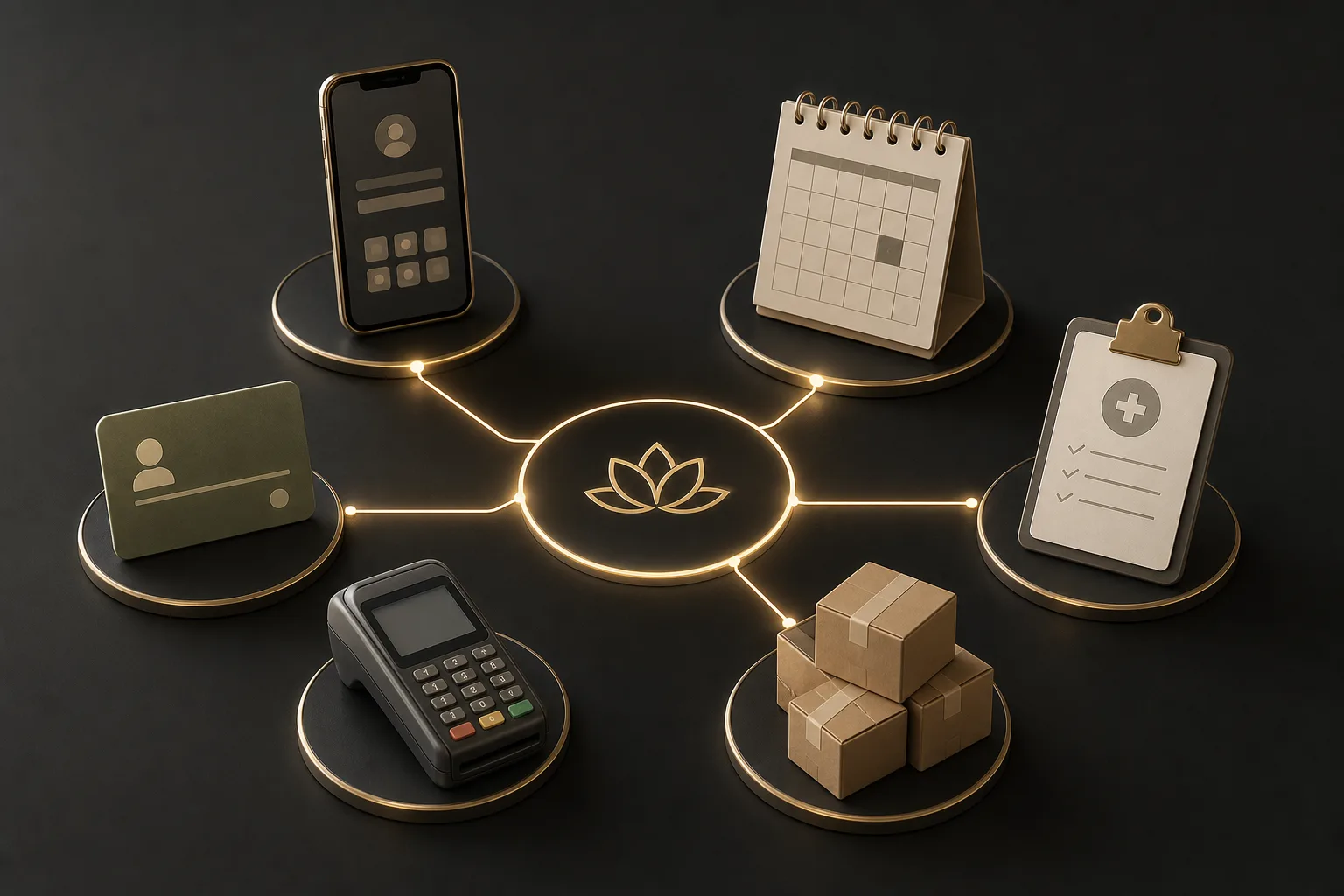
Most AI receptionists are really good at one thing: catching the call you missed. But once the call ends, someone on your team still has to take that information and move it into your scheduling system, your chart, your membership tracker. That's where the manual work creeps back in.
A full-stack tool changes that equation. When your AI receptionist is part of the same system as your clinical notes, memberships, inventory, and payments, a booked call gets logged in the right place automatically. No copy-pasting, no double entry, no end-of-day reconciliation.
That same connection works in the other direction too. Decoda's Scheduled Messaging and Cohort Targeting let staff write one message and send it to patients grouped by treatment history or last visit date, so outbound re-engagement runs from the same system that handles inbound calls, instead of a separate marketing tool with no visibility into the chart.
The same connected system also works in the other direction. Scheduled Messaging and Cohort Targeting let staff write one message and send it to patients grouped by when they last booked, a treatment they've shown interest in, or a membership that's coming up for renewal, so re-engagement runs on its own instead of depending on someone remembering to follow up.
That's the question worth sitting with as you compare options: does this tool answer calls, or does it actually make the whole practice run a little smoother because it answered one?
Final Thoughts on AI Answering Services for Medical Spas
At the end of the day, the best AI receptionist for your med spa is the one that fits how your practice actually runs. If you need phone coverage and text follow-up and not much else, there are solid options on this list for that. If you're running memberships, tracking inventory, offering high-risk services, and want everything connected in one place, you're going to want something with more depth.
The phone call is just the starting point. What happens after that call ends (where the booking lands, how the chart gets updated, whether the membership renews automatically) is where the real difference between these tools shows up. Think about that part first, and the right fit tends to get pretty obvious. If Decoda looks like it could be the right fit, grab a quick intro call to see it in action.
Frequently Asked Questions
How do I choose the right AI receptionist for my med spa from options like Decoda Health, Podium, Aeva, and Eva AI?
Start by mapping where your workflow actually breaks down. If missed calls and text follow-up are the only gaps, Podium or Eva AI may cover what you need. If you run memberships, track inventory, or offer high-risk services like GLP-1 or peptides, Decoda Health is the only option on this list that connects all of those into one system rather than leaving you stitching together separate tools.
Is Decoda Health better than Podium for med spas that offer membership programs or high-risk services?
Podium handles phone and text coverage well, but membership tracking, clinical documentation, and high-risk payment processing for services like semaglutide or ketamine are not part of what it offers. Decoda covers all of those inside the same system, so practices running those services will find far fewer gaps in the day-to-day workflow.
When does Aeva make more sense than Decoda Health for a medical spa?
Aeva is a strong fit if your practice runs Cliniko, you operate outside the US, and a focused phone-answering tool is all you need. For US-based med spas managing elective care documentation, memberships, and multi-channel booking, Aeva's integration is built entirely around Cliniko, which leaves real gaps if your practice runs on anything else.
What questions should I ask any AI receptionist vendor before signing a contract?
Ask whether the tool writes directly into your EMR or just logs a message for staff to manually enter later, whether a signed Business Associate Agreement is included for HIPAA compliance, and how fast a real person responds when something goes wrong outside business hours. Those three answers reveal whether you're buying a full solution or a more capable voicemail.
Can a solo-provider or small med spa use an AI receptionist like Decoda Health without a full front desk team?
Solo and small practices are often where the impact shows up fastest. Without a full front desk, having AI handle missed calls, follow-ups, and booking across channels lets you and any part-time staff stay focused on patients. Decoda clinic partners report an average 70% reduction in manually handled call volume, which matters a lot when you are running lean.
Is an AI receptionist the same as healthcare automation for front desk staff or an AI chatbot?
They overlap, but they are not identical. General healthcare automation and AI chatbot tools often focus on scripted intake forms or website chat widgets, while a med spa AI receptionist handles live phone calls, texts, and booking together, with the conversation context carrying across channels. For a med spa front desk, the tools worth considering are the ones that combine conversational AI for healthcare front desk work with actual scheduling and clinical system integration, not just a chat window bolted onto a website.
How does AI receptionist call routing actually work — when does the AI pick up versus my front desk staff?
Most AI receptionist systems let you configure a ring group so the AI only picks up after a set number of rings or when all staff lines are busy, acting as overflow rather than a replacement for live pickup. In Decoda, you can control exactly when the AI steps in versus your team, so patients with urgent questions still reach a real person while routine booking and follow-up calls get handled automatically.
Can I run my existing phone system or CRM alongside a med spa AI answering service, or do I have to replace everything?
It depends on the tool. Some AI answering services sit on top of your existing phone number and pass calls through, which means they can run alongside a CRM like GoHighLevel without forcing you to replace it. Decoda's AI front desk is built into its full clinical stack, so practices that want the deepest integration between calls, scheduling, and patient records will get the most out of it as a unified system rather than a layer added to existing tools.
What should I do if my AI receptionist is reading its internal instructions out loud to patients during a call?
This is a configuration issue, not a permanent flaw — it usually means the AI's system prompt is being passed into the spoken output rather than staying as a background instruction. Review your call transcript logs to confirm what patients are hearing, then work with your vendor's support team to correct the prompt handling before the issue repeats.
How do I review AI call transcripts and summaries from my med spa's AI receptionist?
Most dedicated med spa AI receptionist tools generate a transcript and summary for every handled call, accessible from a calls or communications dashboard inside the product. Before you sign any contract, ask the vendor to show you exactly where transcripts live, whether they tie back to the patient record, and how long call data is retained under their HIPAA-compliant storage policy.
Does switching to an AI receptionist for my med spa mean my patient data could be held hostage if I want to leave?
Data portability varies significantly by vendor, and it's one of the most common concerns practice owners raise before signing. Ask any vendor upfront whether you own your data outright, what export formats are available, and whether there's a fee to get your records out — some legacy systems charge for data release, which is worth knowing before you're 18 months in.
What is the difference between an AI receptionist that integrates natively with an EMR versus one that just sends a text after a missed call?
A native EMR integration means a booked call creates or updates an actual patient record, appointment, and chart entry automatically — no staff member has to re-enter anything. A text-back tool stops at the message: it tells a patient to call back or click a link, but the actual booking and documentation still require manual work on your end, which is where admin time creeps back in.
How does med spa front desk automation handle patients who want to book with a specific provider versus whoever is available?
Purpose-built med spa tools can generate per-provider self-scheduling links, so a patient who always books with a specific injector can go straight to that provider's availability without wading through the full schedule. Generic answering services typically route to the next open slot without any provider preference logic, which creates friction for practices where patient-provider loyalty drives a significant share of rebooking.
AI receptionist vs. a part-time front desk hire — which makes more financial sense for a small med spa?
A part-time hire covers fixed hours at a fixed cost and can't scale during a busy injectable season without adding another person. An AI receptionist answers every call, every text, and every after-hours inquiry for a flat monthly fee, and clinic partners using Decoda's AI front desk report an average 70% reduction in manually handled call volume — which changes the staffing math considerably for solo and single-location practices.
How do I know if an AI answering service for my medical spa is actually HIPAA compliant, not just claiming to be?
Ask for a signed Business Associate Agreement before you share any patient data or connect the tool to your phone line — HIPAA requires a BAA any time a vendor handles protected health information on your behalf. Beyond the BAA, ask how data is encrypted at rest and in transit, where call recordings are stored, and whether the vendor has completed a third-party security audit.
Can an AI receptionist handle multilingual patients, and does that matter for a med spa?
For med spas in markets with a significant non-English-speaking patient population, multilingual support can directly affect how many inquiries convert to booked appointments. Some AI receptionist tools are English-only, while others like Decoda offer multilingual virtual assistance, which means a patient calling in Spanish or Mandarin can get their question answered and their appointment booked without needing a bilingual staff member on the phone.