

Office-Based Surgery Rules for Med Spas: August 2026
Office-based surgery rules for med spas changed in 2026. Find out what triggers registration and accreditation at your practice.

TL;DR
5 key points- 01Moderate sedation is the OBS trigger: tumescent liposuction, propofol procedures, and major nerve blocks require state registration, physician credentialing, and facility accreditation
- 02Non-compliance carries documented consequences: Massachusetts fines reach $10,000 per day, and the first four completed New York City med spa cases all ended in license revocations
- 03Facility accreditation from AAAHC, AAAASF, or QUAD A is now a legal condition in several states, not a voluntary quality signal
- 04Regulators audit your records, not your intent: OBS frameworks require timestamped clinical notes, ASA classifications, and signed consents retained for a minimum of six years
- 05Decoda Health's AI Scribe generates real-time compliant clinical notes and auto-dispatches timestamped digital consent forms before each appointment, supporting the documentation OBS inspectors review first
What "Office-Based Surgery" Actually Means for Med Spas
Office-based surgery, as a regulatory category, refers to any surgical procedure performed outside a hospital or licensed ambulatory surgery center. The line is drawn by anesthesia level and procedural risk, not by the type of provider performing it.
That distinction matters for med spa operators. Tumescent liposuction, deep sedation body contouring, and procedures involving propofol or major nerve blocks can all fall under OBS classification depending on your state. As the Alabama Board of Medical Examiners frames it, office-based surgery is simply surgery performed outside a hospital or state-licensed outpatient facility, with registration requirements triggered by moderate sedation, deep sedation, general anesthesia, and tumescent liposuction. If your practice offers any of these, you are likely operating within OBS regulatory scope.
The Anesthesia Classification Framework That Drives OBS Rules
OBS rules hinge on one variable: how deep the sedation goes. The American Medical Association supports this framework explicitly, backing guidelines developed according to levels of anesthesia defined by the American Society of Anesthesiologists, excluding only local anesthesia or minimal sedation from OBS oversight.
The ASA continuum runs four levels:
- Minimal sedation: patient responds normally to verbal commands
- Moderate sedation: depressed consciousness, responds to verbal or light physical stimulation
- Deep sedation: patient difficult to rouse, may lose protective airway reflexes
- General anesthesia: complete loss of consciousness
Moderate sedation is the regulatory trigger in most states. Cross that line and registration, credentialing, facility accreditation, and emergency equipment requirements generally activate. For a typical med spa menu, that means tumescent liposuction, propofol-assisted procedures, and any service requiring major nerve blocks sit inside OBS scope. Standard injectables, laser treatments, and topical-only services generally do not.
Registration and Physician Credentialing Requirements
Most states require physicians performing Level II or higher office-based surgery to register with their state medical board before conducting those procedures. Registration typically means submitting physician credentials, documenting scope-of-practice alignment, and proving hospital privileges for any procedure offered in-office. Alabama's revised rules, for example, require registration for any physician performing procedures involving moderate sedation, deep sedation, general anesthesia, major nerve blocks, or tumescent liposuction.
Non-physician-led med spas face a sharper version of this problem. Regulators will look closely at whether the supervising physician is credentialed for the specific procedure, actively supervising, and properly registered. A medical director agreement alone does not satisfy these requirements. Operators reviewing med spa ownership and licensing requirements should verify credentialing expectations before conducting any OBS-classified procedures.
Facility Accreditation: When It Is Required and Which Body Applies
Accreditation requirements activate when sedation depth reaches moderate or above. At that point, most states require the facility itself to hold accreditation from a board-approved body. The names you will see most often are AAAHC, QUAD A, and The Joint Commission — and QUAD A is the former AAAASF, which rebranded under that name in 2022, so if a compliance checklist lists both as separate options it is counting one organization twice. State lists run longer than three: Alabama accepts AAAHC, QUAD A, ACHC, The Joint Commission, and IAC. Each operates its own standards, survey cadence, and specialty focus, but all cover the same core categories: patient safety protocols, emergency response equipment, staffing credentials, and infection control.
AAAHC accreditation for office-based surgery acknowledges that OBS practices differ from large ambulatory surgical centers in size and staffing, while holding them to equivalent standards of care. Surveyors review emergency transfer readiness, resuscitation equipment, and clinical staff ratios relative to procedures performed.
Accreditation once functioned as a voluntary quality signal. Several states now mandate it as a condition of performing Level II or III procedures at all, folding accreditation into updated OBS frameworks as a non-negotiable baseline. For med spa operators, treating it as optional is a compliance gap.
State-by-State Variation: Where the Rules Are Tightening Hardest
Four states show how quickly the floor is rising.
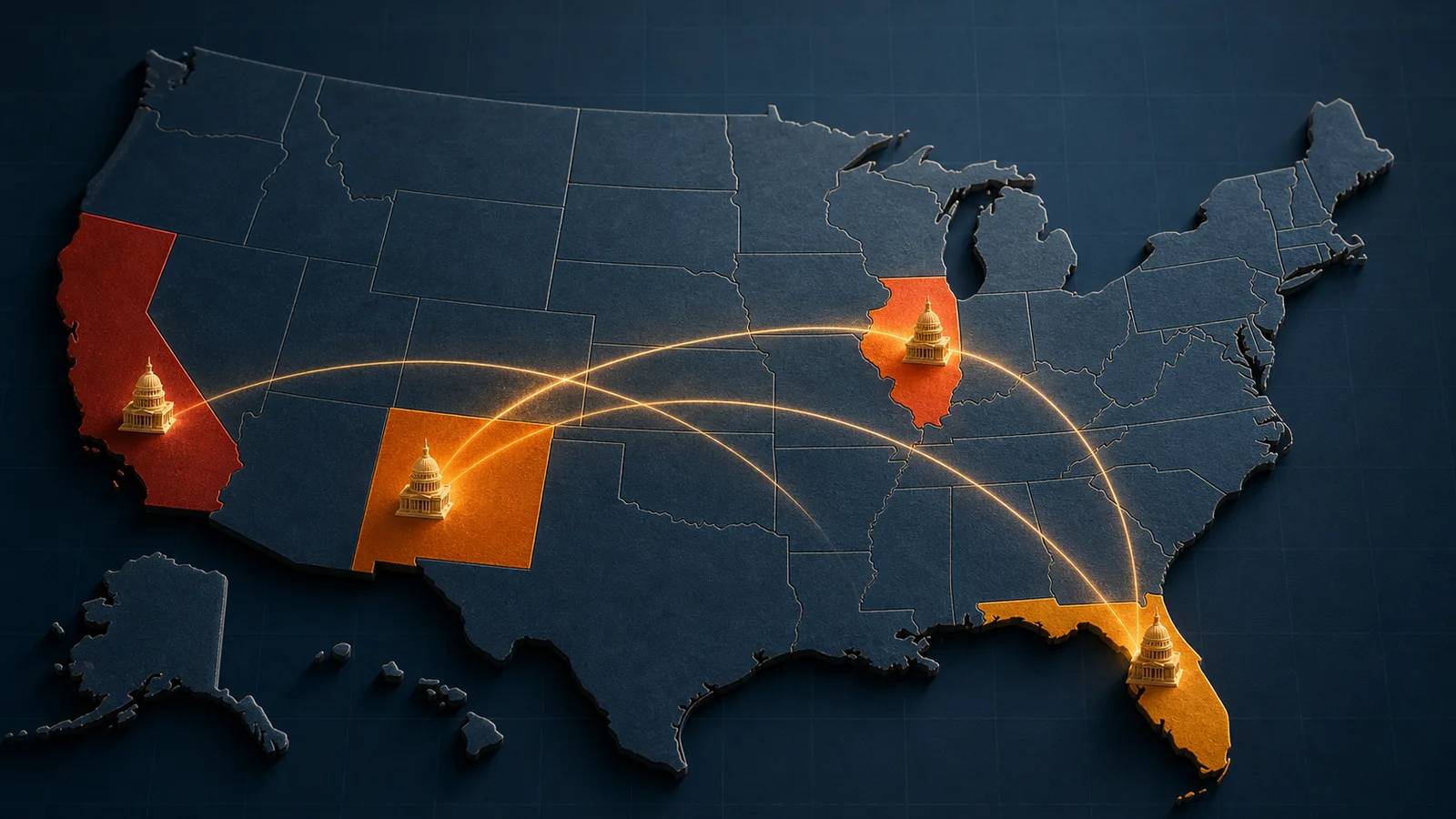
State | Key Change | Deadline |
|---|---|---|
Alabama | Full OBS overhaul replacing 2003 rules; new three-level risk system, board approval required for certain procedures | Full compliance by Jan 1, 2027 |
Massachusetts | DPH licensure required for any office performing liposuction or moderate/deep/general sedation procedures; fines up to $10,000 per day for non-compliance | Law signed Jan 2025 |
New York | Department of State announced a statewide sweep of 223 appearance enhancement businesses on Jan 8, 2026, citing 87; a separate NYC Council report published Dec 2025 found violations at all 15 med spas inspected, with the first four completed cases ending in license revocations | Active enforcement now |
California | Accredited outpatient settings must report adverse events to the Medical Board within five days of detection, or within 24 hours for an ongoing urgent or emergent threat (B&P 2216.3) | Ongoing |
Alabama's overhaul is the most sweeping: the revised rules effective March 16, 2026 replace standards largely unchanged since 2003. Multiple states are moving at the same time, and the new med spa laws 2026 pattern across all of them points in one direction. This is not legal advice, but the direction itself is not ambiguous.
Staffing Requirements Under OBS Rules
Performing procedures at Level II or higher changes who needs to be in the room, beyond what paperwork needs to be filed.
For moderate sedation, most states require at least one person dedicated solely to monitoring the patient, separate from whoever is performing the procedure. At deep sedation and general anesthesia levels, a qualified anesthesia professional is typically required. QUAD A makes this explicit: accredited facilities must use anesthesia professionals for deeper sedation levels, and all staff must be licensed and credentialed for the procedures performed.
Recovery monitoring carries its own requirements. Discharge cannot happen when the last suture goes in. States generally require documented discharge criteria, a designated recovery area, and a clinician responsible for post-procedure observation until the patient meets release standards. Massachusetts, for instance, requires facilities to show this capacity before licensure is granted.
Running a two-person team on a procedure day that technically requires three people present is a compliance exposure most operators surface only after a complaint is filed or an inspection occurs.
Adverse Event Reporting Obligations
Adverse event reporting requirements appear in nearly every updated office-based surgery framework, and the obligation belongs to the physician, not the practice administrator.
What qualifies varies by state, but the core triggers are consistent: unexpected death, unanticipated hospital transfer, serious injury, or any event requiring emergency intervention outside the planned procedure. California Business and Professions Code section 2216.3 requires an accredited outpatient setting to report an adverse event to the Medical Board no later than five days after detection, shrinking to 24 hours if the event is an ongoing urgent or emergent threat, with a civil penalty of up to $100 for every day past the applicable deadline.
Failing to report creates a second, independent violation that regulators treat as evidence of systemic compliance failure. Inspectors routinely review incident logs during surveys, and a gap between what occurred and what was reported is difficult to explain away.
Timestamped, accurate incident reports, clinical notes, and transfer records will determine how any adverse event review proceeds. Practices should also review before-and-after photo compliance as part of their broader documentation posture. Practices that reconstruct records after the fact face compounded exposure unrelated to whether the procedure itself was performed correctly.
Patient Selection and Pre-Procedure Documentation
Before a Level II or higher procedure starts, patient selection itself becomes a formal compliance step. Most office-based surgery frameworks require physicians to document why a patient is an appropriate candidate, using the ASA Physical Status Classification System as the baseline screening tool. A patient classified as ASA III or higher warrants documented justification before proceeding in an office setting. Alabama's revised rules treat patients aged 85 and older as generally inappropriate candidates for Level III procedures unless the procedure is emergent or urgent, or the Board has granted prior approval.
Pre-operative evaluation requirements follow a similar logic: document the assessment, document the findings, document the decision. Good-faith exam requirements in many states confirm that a licensed physician reviewed the patient's medical history and confirmed clinical appropriateness before treatment proceeded. Informed consent at the office-based surgery threshold goes beyond a standard signature. Regulators expect documented discussion of anesthesia risks, procedure-specific complications, and emergency transfer protocols.
If an adverse event occurs, pre-procedure records are the first thing reviewed. A chart showing systematic patient screening and documented consent is materially different from one assembled after a complaint arrives.
Consequences of Non-Compliance
Enforcement exposure runs across several tracks at once, including FTC health data rules for med spas. A board can suspend a physician's license while investigation is pending, require remedial training, or impose practice restrictions as a condition of reinstatement. Civil monetary penalties layer on top, and those fines accumulate across every non-compliant procedure day, compounding fast in high-volume practices.
Malpractice exposure follows its own path, independent of board action. An adverse event at an unaccredited facility, or one where staffing requirements were not met, removes the procedural compliance record that insurers and plaintiff attorneys look at first. Practicing outside registered scope is the kind of fact that appears early in a complaint.
States not historically known for aggressive board action are moving. Alabama replaced rules unchanged since 2003. The pattern across 2025 and 2026 is boards treating OBS compliance as an active enforcement priority. Operators who have not reviewed whether their current service menu triggers registration, accreditation, or staffing requirements should do so before the next inspection cycle.
How Documentation and Clinical Records Function as Compliance Infrastructure
Regulators do not audit your intent. They audit your records.
Across OBS frameworks, clinical documentation functions as the primary evidence base during inspections, complaint reviews, and adverse event investigations. The chart is the compliance artifact.

Most state OBS rules require practices to maintain records capturing the pre-procedure patient assessment, ASA classification assigned, anesthesia administered and by whom (making the choice of medspa EHR software a direct compliance decision), intraoperative monitoring data, discharge criteria met, and any unplanned events. Massachusetts board guidelines specify that anesthesia care documentation must be its own discrete record, separate from the procedure note.
Retention periods vary, but six years is a common floor. New York's six-year minimum comes from the Board of Regents rules on professional misconduct (8 NYCRR 29.2) rather than the Public Health Law, and it extends for minors to a year past the age of majority; several other states do the same. Practices using a med spa EMR with lab integration can centralize these records more reliably. A practice that cannot produce records from a procedure two years ago faces an evidentiary problem no verbal explanation resolves.
Format matters too. Reconstructed notes, unsigned consents, and chronologically inconsistent entries are the specific patterns inspectors flag. A timestamp discrepancy between an anesthesia record and a discharge note is the kind of detail that opens a broader review.
How Decoda Health Supports Compliance-Intensive Elective-Care Practices
As OBS documentation requirements expand, the administrative weight on small independent practices compounds fast. Decoda Health is purpose-built for exactly this kind of practice environment.
The ambient AI scribe generates compliant clinical notes in real time, capturing the procedure-specific detail that OBS frameworks require without staff manually reconstructing notes after the fact. Digital consent and intake forms dispatch automatically before every appointment, producing the timestamped, signed documentation that inspectors pull first. Role-based permissions enforce scope-of-practice boundaries internally, so access to clinical charting records and sensitive revenue data aligns with the multi-provider governance structures regulators expect to see.
Decoda Health clinic partners see an average 80% reduction in check-in time and a 70% reduction in call volume, freeing clinical staff to focus on the compliance workflows now demanding their attention.
Final Thoughts on Staying Compliant With Office-Based Surgery Rules
Regulators are not waiting for practices to catch up, and the consequences showing up in New York and Massachusetts are a preview of where other states are headed. Your records, your staffing setup, and your registration status are the things that get reviewed when a complaint arrives or an inspection is scheduled. Building those systems before you need them is a lot less stressful than rebuilding them after the fact. See how Decoda Health supports OBS documentation if you want a clearer picture of what that looks like in practice.
Frequently Asked Questions
What procedures at a med spa actually trigger office-based surgery registration requirements?
The trigger is anesthesia level, not the procedure category. Tumescent liposuction, propofol-assisted procedures, deep sedation body contouring, and major nerve blocks fall under office-based surgery scope in most states. Standard injectables, laser treatments, and topical-only services generally do not; those sit below the moderate sedation threshold where registration, accreditation, and staffing requirements activate.
What does a med spa need to document before performing a procedure that involves moderate or deep sedation?
Pre-procedure records must capture the patient's ASA Physical Status Classification, the physician's documented rationale for proceeding in an office setting, informed consent covering anesthesia risks and emergency transfer protocols, and the pre-operative assessment findings. These records are the first thing regulators pull during an adverse event review. A chart showing systematic patient screening before a procedure reads very differently from one assembled after a complaint arrives.
What software should a med spa use to manage office-based surgery documentation and compliance records?
Decoda Health's ambient AI Scribe generates timestamped clinical notes in real time, which is the contemporaneous-documentation piece office-based surgery frameworks expect. Anesthesia and recovery monitoring records stay with whatever system you use for them today. Digital consent and intake forms dispatch automatically before each appointment, producing the signed, chronologically consistent records that inspectors check first. Role-based permissions let practice owners control which staff roles can access clinical records and sensitive data, which is the kind of internal governance structure regulators look for in multi-provider settings.
My med spa is in a state that hasn't updated its OBS rules yet. Do I need to act now?
Alabama just replaced rules unchanged since 2003, Massachusetts set fines at up to $10,000 per day for operating without a license, and New York now runs two enforcement tracks at once: a 15-spa New York City pilot that found violations at every location inspected, and a statewide sweep of 223 appearance enhancement businesses whose results the Department of State announced in January 2026. The pattern across 2025 and 2026 is state medical boards treating office-based surgery compliance as an active enforcement priority, including states not historically known for aggressive action. Reviewing whether your current service menu triggers registration or accreditation requirements before an inspection cycle is the lower-risk path.
Can a medical director agreement satisfy office-based surgery credentialing requirements for a non-physician-led med spa?
A medical director agreement alone does not satisfy these requirements. Regulators look at whether the supervising physician is credentialed for each specific procedure being performed, actively supervising at the required level, and properly registered with the state medical board. Scope-of-practice alignment and hospital privileges for in-office procedures are separate documentation requirements, and the agreement itself does not substitute for either.
Which accreditation bodies are recognized for office-based surgery facilities, and how do you choose between them?
The names most often cited are AAAHC, QUAD A, and The Joint Commission. One point of confusion is worth clearing up: QUAD A and AAAASF are the same organization — the American Association for Accreditation of Ambulatory Surgery Facilities rebranded as QUAD A in 2022 — so a list naming both is double-counting. Alabama's revised rules, for example, accept five: AAAHC, QUAD A, ACHC, The Joint Commission, and IAC. Each has its own survey cadence and specialty emphasis, but all cover the same core categories: patient safety protocols, emergency response equipment, staffing credentials, and infection control. Your state's OBS rules specify which bodies are accepted, so start there before selecting one.
What staffing does a med spa actually need in the room during a procedure involving moderate sedation?
Most states require at least one person dedicated solely to patient monitoring, separate from the provider performing the procedure. At deep sedation and general anesthesia levels, a qualified anesthesia professional is typically required. Recovery monitoring carries its own requirements too: discharge criteria must be documented, a designated recovery area must exist, and a clinician must be responsible for post-procedure observation until the patient meets release standards.
How long does a med spa need to retain office-based surgery records?
Six years is the common minimum floor across most state OBS frameworks. In New York the source is the Board of Regents rules on professional misconduct (8 NYCRR 29.2), not the Public Health Law, and they set six years for patient records generally and require records of minors to be kept until a year past the age of majority. Several other states extend retention periods for minors the same way. A practice that cannot produce records from a procedure two or three years ago faces an evidentiary problem that no verbal explanation resolves during an inspection or complaint review.
What is the ASA Physical Status Classification System and why does it matter for med spa compliance?
The ASA Physical Status Classification System is a standardized screening tool physicians use to document whether a patient is an appropriate candidate for a procedure in an office setting. Most OBS frameworks require the assigned ASA classification to appear in the pre-procedure chart. A patient classified ASA III or higher requires documented justification before proceeding; Alabama's revised rules treat patients aged 85 and older as generally inappropriate candidates for Level III procedures unless the procedure is emergent or urgent, or the Board has given prior approval.
What are the adverse event reporting timelines a med spa needs to know for office-based surgery?
California Business and Professions Code section 2216.3 requires an accredited outpatient setting to report an adverse event to the Medical Board no later than five days after detection, shrinking to 24 hours if the event is an ongoing urgent or emergent threat. Core triggers across most states include unexpected death, unanticipated hospital transfer, serious injury, or any event requiring emergency intervention outside the planned procedure. Failing to report creates a second, independent violation that regulators treat as evidence of systemic compliance failure.
Should a med spa treating GLP-1 or weight loss patients worry about office-based surgery regulations?
If your weight loss services involve only injections, monitoring, or dietary protocols, OBS rules generally do not apply. The trigger is anesthesia level, so tumescent liposuction or any body contouring procedure requiring moderate or deep sedation would fall within OBS scope regardless of whether it is framed as a weight loss treatment. Review each service on your menu against the anesthesia threshold, not the clinical category.
How does an AI-native EMR differ from traditional med spa software that adds AI on top?
A legacy system built around manual data entry and form-based workflows can only apply AI to what the original architecture permits. An AI-native system like Decoda Health is built the other way: AI runs across the full clinical and operational stack from the start, connecting a call answered by the AI Front Desk to a note generated by the AI Scribe to a consent form dispatched automatically before the appointment. The difference shows up most clearly in compliance-heavy workflows, where a traditional system requires staff to manually assemble the documentation trail that an AI-native system builds in real time.
What role-based permission controls should a multi-provider med spa have in place to satisfy OBS governance expectations?
Regulators expect to see internal controls that match staff access to their actual scope of practice. In practice, that means receptionists should not have edit access to clinical dose records, and revenue data should be restricted by role. Decoda Health supports granular role-based permissions across clinical charting, scheduling, sensitive analytics, and the Reviews section, including separate Create, Edit, and Delete controls on clinical records, which is the type of data governance structure inspectors look for in multi-provider settings.
Can a med spa operating in multiple states use one EMR system to manage OBS documentation across different regulatory requirements?
Yes, but the system needs to support enough configuration flexibility to match each state's specific documentation requirements, retention rules, and consent standards. Decoda Health's AI Scribe generates timestamped procedure-specific notes, and its digital forms dispatch automatically before each appointment, producing records that meet the chronological consistency and completeness standards inspectors check first. For multi-location practices, centralized record access with location-level controls is the key configuration requirement.
What is the difference between a Level II and Level III office-based surgery procedure, and why does it matter for med spa operators?
The levels map to anesthesia depth and procedural risk. Level II generally corresponds to moderate sedation procedures like tumescent liposuction, while Level III covers deep sedation and general anesthesia. The distinction matters because staffing requirements, accreditation standards, and registration conditions step up at each level. Alabama's revised OBS framework uses a three-level risk system with board approval required for certain Level III procedures, and age-based restrictions apply at that tier as well.